Present Day
 |
| http://img-aws.ehowcdn.com/400x400/ds-img.studiod.com/Tibet_and_surrounding_areas_t_1.png |
With names like, "the roof of the world" and the "Asian water tower," to name a few, the Tibetan Plateau provides a great geological area of importance. This area is said to provide water to the majority of Asia, which also provides a great culture importance as well. The Tibetan Plateau is the highest of all plateaus in the world, with the highest elevation at around 16,000 feet. According to the Chinese Academy of Sciences, this plateau provides the largest tropical glaciological area in the world, surrounded by the highest mountain peaks such as the Himalayas, Karakora, and the Pamir mountain ranges all in this area. The Tibetan Plateau on the side of China alone, is said to accommodate over 37,000 glaciers that feed Asia's largest rivers. According to National Geographic, over two-billion people in more than a dozen counties--which is more than a third of the earths population--are dependent on the rivers fed by these glaciers.
 |
| https://pubs.usgs.gov/gip/dynamic/graphics/Fig24tibet.gif |
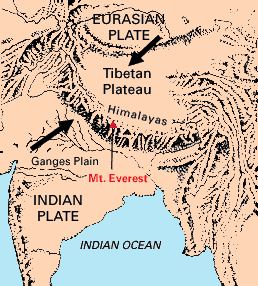
Under Tibet, there are two continental plates: the Indian/Australian plate and the Eurasian plate. The Tibetan Plateau was created due to the pile up of these plates crashing into one another, some time during the Paleozoic and Mesozoic eras. After the collision, more of the area that was mushed together is now involved in the tectonic changes that are occurring. The southern and central portions of Tibet are reaching higher levels while the northern portions have remained lower and were said to be sinking. Material from the lithosphere, or the outer shell of the planet, from below the surface was pushed out towards the East. Moreover, the easterly movement aided the pieces of the lithosphere along the subduction trenches in the Pacific, into what is now known as China.
Tibetan Plateau in 10,000 Years
 |
| http://futuredirections.org.au/wp-content/uploads/2014/05/Climate_Change_Tibet_Image_2.bmp |
|
|
According to research, the Intergovernmental Panel on Climate Change (IPCC) produced a report in 2014 stating the Himalayan glaciers will loose a third, to even one half of its mass by the year 2100. The IPCC reports that this is due to the surface temperature increase of 1.8 degrees Celsius from 2006, which will cause the 45% glacier loss by 2100. Now this is all situational of course depending on global warming and the green house effect, which India and China are the biggest emitters of fossil fuel carbon dioxide. These areas also create what is called ‘atmospheric brown clouds' made up of aerosol and black carbon soot, which breaks down ice and snow at a much higher rate. Now as far as the peaks go, in the last 50 million years, Mt. Everest has grown about 9km. This is about 1cm a year due to the plates below still colliding. When taking the data and the above picture into perspective, my hypothesis is that at the rate we are going the glaciers will continue to deteriorate leaving less than 50% and causing flooding to lower areas and the forestry to move higher up into the mountains. The melting of these glaciers will also play a significant part on the Asian monsoon season as well.
Tibetan Plateau in 1,000,000 and 10,000,000 Years
There tends to be a lot of uncertainty and conflicting information on the effects of the glaciers and the Tibetan Plateau's future. If the atmosphere stays the same or gets worse, the glaciers should be long gone in 1,000,000 years. Or will the continuation of the Indian/Australian and Eurasian plate push the peaks higher to continue to maintain the low atmospheric pressure to maintain the glaciers? Another possibility is the domino effect causing earthquakes along the fault of the landscape due to pressure built up in the Earths crust caused by the plate tectonic forces. This ideology comes from some of the worlds most devastating earthquakes caused by continuous plate tectonic processes.
Conclusion
Global warming and the green house effect tend to have serious long term complications all over the world. Ultimately, if we as guests on this Earth do not start taking these things seriously, the damage will be irreversible. Of course we cannot stop plate-tectonics but we can begin to take things like El Nino seriously and start conserving wherever we can. Hopefully, more reliable resources will become available in reference to the Tibetan Plateau. If so, our contributions to climate change can be addressed before the millions of people who rely on these glacier run-offs run out of this valuable resource.
Citations
Bruscke, Kate (ND). Tibetan Plateau Facts, USA Today. retrieved from: http://traveltips.usatoday.com/tibetan-plateau-100235.html
Institute of Tibetan Plateau Research, Chinese Academy of Sciences: Introduction“National Geographic”; The Big Melt; Brook Larmer; April 2010
Thompson, Andrea (2008). Live Science, The real story behind the "roof of the world." Retrieved from:http://www.livescience.com/5068-real-story-roof-world.html
Levacher, Cécil
, (2014).
Topic\
Global Food and Water Crises\
Climate Change in the Tibetan Plateau Region: Glacial Melt and Future Water Security. Retrieved from: http://www.futuredirections.org.au/publication/climate-change-in-the-tibetan-plateau-region-glacial-melt-and-future-water-security/

